2026 Production Secrets: 5 VFX Techniques Revolutionizing Dramas
Dive into the future of television with an exclusive look at the 2026 production secrets, highlighting five cutting-edge VFX techniques that are set to redefine visual storytelling in global dramas.
By: Monica Rose on February 2, 2026
As the curtain rises on the future of entertainment, audiences worldwide are hungry for more immersive and visually stunning narratives. The landscape of global dramas is undergoing a seismic shift, driven by technological advancements that were once confined to the realm of science fiction. We’re here to share some of the most exciting 2026 production secrets, focusing on five revolutionary VFX techniques that are not just enhancing, but fundamentally transforming how stories are told and perceived on screen.
The rise of virtual production and in-camera VFX
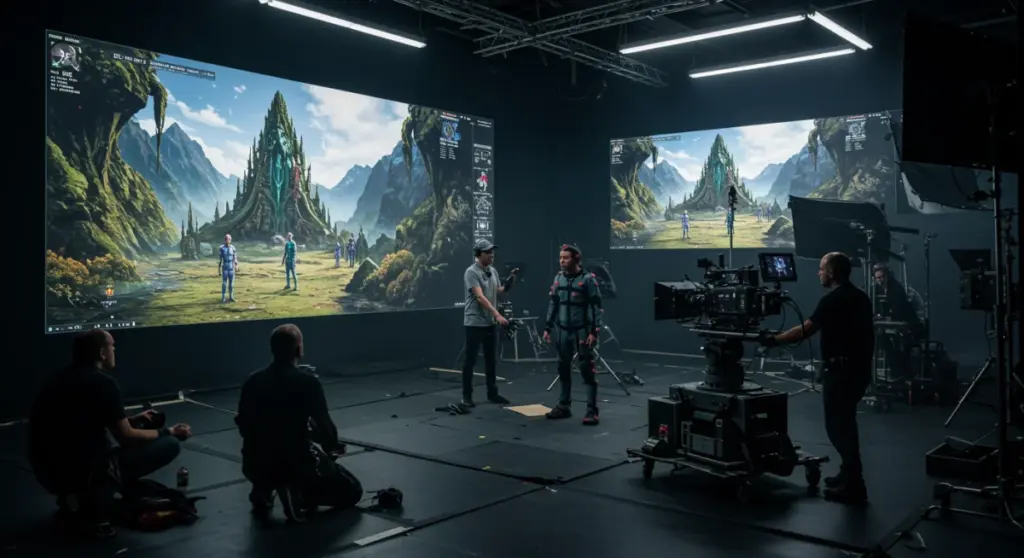
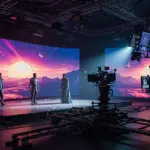
Virtual production has emerged as a game-changer, blurring the lines between physical and digital filmmaking. This technique allows filmmakers to create and render digital environments in real-time on massive LED screens, serving as dynamic backdrops for live-action filming. The implications for global dramas are profound, offering unprecedented creative control and efficiency.
The ability to see the final composite shot directly on set, rather than waiting for post-production, streamlines workflows and empowers directors to make immediate creative decisions. This also significantly reduces the need for extensive green screen work, allowing actors to perform within their digital environments, leading to more authentic and reactive performances.
real-time rendering and creative freedom
Instant Visual Feedback: Directors and cinematographers can adjust lighting, set extensions, and even entire environments on the fly, seeing the results instantly.
Enhanced Actor Performance: Actors react to realistic, dynamic environments instead of green screens, fostering more natural and believable portrayals.
Reduced Post-Production Time: Many visual effects are captured in-camera, cutting down on time and costs traditionally associated with post-production.
Global Collaboration: Teams can collaborate across continents, sharing and refining virtual sets in real-time, accelerating international co-productions.
The integration of virtual production means that a historical drama can be shot in a virtual ancient Rome one day and a futuristic cityscape the next, all within the same studio. This flexibility is invaluable for complex international productions seeking to tell ambitious stories without the logistical nightmares of extensive location shooting.
Volumetric capture: bringing characters to life in 3D
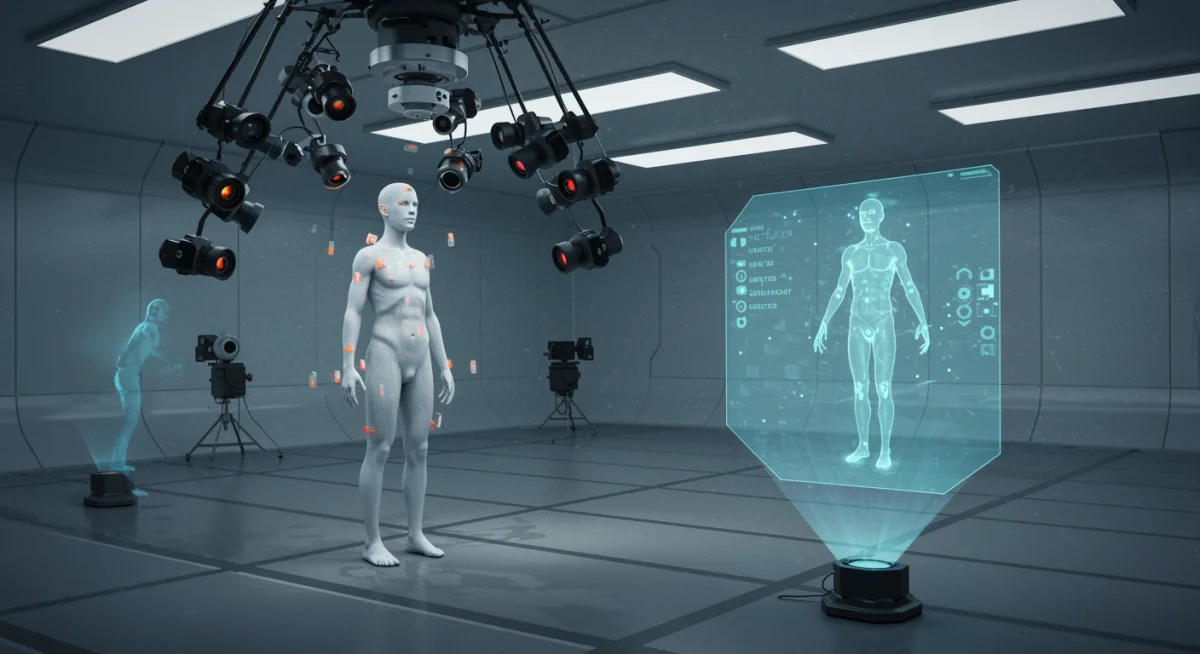
Volumetric capture is perhaps one of the most exciting 2026 production secrets, enabling the creation of truly three-dimensional digital assets of actors and objects. Unlike traditional motion capture, which only records skeletal movement, volumetric capture records the entire visual appearance of a subject from all angles, creating a lifelike 3D model that can be manipulated and integrated into any digital environment.
This technology is revolutionizing character creation and interaction within virtual worlds. Imagine historical figures or fantastical creatures rendered with such fidelity that they are indistinguishable from live actors, capable of subtle expressions and movements that elevate storytelling to new heights.
applications in diverse genres
From period pieces to sci-fi epics, volumetric capture offers unparalleled realism. It allows for the preservation of actor performances, creating digital doubles that can be used for dangerous stunts, age manipulation, or even to continue a performance if an actor is unavailable. This technique is particularly valuable for dramas that require intricate character interactions with highly detailed digital environments or creatures.
Furthermore, volumetric capture can be used to create interactive experiences alongside traditional linear narratives, allowing audiences to explore characters and scenes from different perspectives, deepening engagement with the story and its world. This opens up new avenues for cross-platform storytelling and fan engagement.
AI-driven content generation and enhancement
Artificial intelligence is no longer just a tool for data analysis; it’s becoming a creative partner in filmmaking. AI-driven content generation and enhancement techniques are set to become a cornerstone of 2026 production secrets, automating tedious tasks and unlocking new creative possibilities. This includes everything from generating realistic background characters to enhancing visual fidelity and even aiding in script development.
AI algorithms can analyze vast datasets of images and video to generate highly convincing digital assets, saving countless hours for VFX artists. This also extends to scene reconstruction, where AI can fill in missing visual information or seamlessly blend different elements, making complex visual effects more achievable and cost-effective for a wider range of productions.
the role of machine learning in VFX pipelines
Automated Asset Creation: AI can generate realistic textures, models, and environments based on minimal input, accelerating pre-visualization and production.
Deepfake and De-aging Technologies: Advanced AI models enable hyper-realistic de-aging or even the recreation of actors, offering new narrative possibilities.
Intelligent Compositing: AI assists in seamlessly blending live-action footage with CGI, automatically detecting edges and adjusting lighting for perfect integration.
Performance Enhancement: AI can subtly enhance actor performances, refining facial expressions or body language to convey specific emotions more effectively.
The ethical implications of AI in content creation are actively being discussed, but its potential to transform the speed and scope of visual effects is undeniable. For global dramas, this means being able to depict more ambitious and visually rich worlds without necessarily inflating budgets to unsustainable levels.
Hyper-realistic digital matte painting and environment creation
Digital matte painting has long been a staple of visual effects, but in 2026, it’s reaching new levels of hyper-realism. Advances in rendering technologies, photogrammetry, and procedural generation are allowing artists to create incredibly detailed and believable environments that are virtually indistinguishable from real locations. These techniques are critical for establishing the mood and scale of global dramas, transporting audiences to fantastical or historically accurate settings.
The integration of high-resolution textures, intricate lighting models, and advanced atmospheric effects ensures that digital environments feel lived-in and authentic. This isn’t just about creating a pretty picture; it’s about building a world that supports the narrative and immerses the viewer completely.
crafting immersive worlds with advanced techniques
Modern digital matte painting often starts with real-world photographic data, which is then meticulously extended and enhanced using 3D modeling and texturing. This hybrid approach allows for a level of detail and realism that was previously unattainable. For instance, a historical drama might recreate an entire ancient city with breathtaking accuracy, providing a rich tapestry for the story to unfold.
The ability to sculpt entire landscapes and cityscapes with such precision means that creative visions are no longer limited by geographical or budgetary constraints. This freedom empowers storytellers to imagine and execute truly epic narratives, making hyper-realistic digital matte painting a key component of future production strategies.
Real-time facial animation and digital doubles
The subtle nuances of human emotion are paramount in drama, and real-time facial animation is taking this to an unprecedented level. Using advanced capture systems and sophisticated rigging, actors’ facial performances can be translated directly onto digital doubles or CGI characters with incredible fidelity. This is a crucial 2026 production secrets for ensuring emotional depth and consistency in visually complex scenes.
Digital doubles are becoming increasingly indistinguishable from their live-action counterparts, not just in appearance but in their ability to convey a full range of human emotion. This technology allows for performances to be captured and applied to digital characters in real-time, facilitating more immediate feedback and iteration during production.
enhancing emotional expression and narrative continuity
Subtle Emotional Conveyance: Capture and replicate the most minute facial expressions, ensuring digital characters convey authentic emotions.
Seamless Digital Integration: Create digital doubles that can perform stunts or appear in fantastical forms without losing the actor’s original performance essence.
Iterative Performance Refinement: Directors can review and adjust facial animations on set in real-time, optimizing emotional impact.
Cross-Cultural Storytelling: Facilitates the accurate depiction of diverse emotional expressions, enhancing the global appeal and understanding of dramas.
The ability to maintain an actor’s performance, even when their character is entirely digital, opens doors for narratives that push the boundaries of reality. Whether it’s a historical figure brought to life with digital precision or a mythical creature imbued with human emotion, real-time facial animation ensures that the heart of the performance remains intact.
Next-generation particle systems and fluid simulations
Beyond static environments and characters, the dynamic elements of a scene—smoke, fire, water, explosions—are equally vital for immersion. Next-generation particle systems and fluid simulations represent another essential aspect of 2026 production secrets, offering unprecedented realism and control over these complex visual phenomena. These advancements allow for highly detailed and physically accurate simulations, making digital effects indistinguishable from real-world events.
These techniques are crucial for enhancing action sequences, creating believable natural disasters, or simply adding atmospheric depth to a scene. The computational power required for such simulations has historically been a bottleneck, but advancements in hardware and software are making these effects more accessible and versatile for drama productions.
dynamic realism for enhanced spectacle
Modern particle systems can simulate millions of individual particles, each behaving according to complex physical rules, to create incredibly convincing effects. Fluid simulations, similarly, can model the intricate movements of water, smoke, and other gases with breathtaking accuracy. This means that a dramatic flood or a raging fire can be depicted with a level of realism that truly captivates the audience.
The ability to precisely control these elements also offers significant creative advantages. Filmmakers can design specific environmental effects to enhance the narrative, adding visual metaphors or intensifying emotional moments. This blend of scientific accuracy and artistic control makes these simulations indispensable for cutting-edge global dramas.
Key Technique
Brief Description
Virtual Production
Real-time rendering of digital environments on LED screens for in-camera VFX, enhancing efficiency and realism.
Volumetric Capture
Captures full 3D visual data of subjects, creating lifelike digital models for seamless integration.
AI-Driven Content
Automates asset generation, enhances visuals, and aids in creative processes using artificial intelligence.
Hyper-realistic DMP
Creates incredibly detailed and believable digital environments through advanced rendering and photogrammetry.
Frequently asked questions about 2026 production secrets
What is virtual production and how does it benefit global dramas?▼
Virtual production utilizes large LED screens to display digital environments in real-time on set, allowing actors to perform within their virtual worlds. This technique enhances realism, reduces post-production time, and provides directors with instant visual feedback, making it ideal for complex global narratives.
How does volumetric capture differ from traditional motion capture?▼
Unlike traditional motion capture, which records skeletal movement, volumetric capture records the entire visual appearance of a subject in 3D from all angles. This creates a fully rendered, lifelike digital model capable of nuanced expressions and movements, offering greater fidelity for digital characters.
What role does AI play in enhancing visual effects for dramas?▼
AI-driven tools automate asset generation, enhance visual fidelity, and assist in seamless compositing. They can create realistic background characters, de-age actors, and optimize visual integration, allowing filmmakers to achieve complex effects more efficiently and cost-effectively for global productions.
Why are hyper-realistic digital matte paintings crucial for future dramas?▼
Hyper-realistic digital matte paintings, combined with photogrammetry and procedural generation, create incredibly detailed and believable environments. These immersive settings are vital for establishing mood, scale, and authenticity in global dramas, transporting audiences to fantastical or historically accurate locations seamlessly.
How do real-time facial animation and digital doubles benefit storytelling?▼
These techniques accurately translate actors’ facial performances onto digital characters or doubles in real-time. This ensures emotional depth, narrative continuity, and allows for performances to be maintained even when characters are fully digital, expanding creative possibilities for complex and emotionally resonant dramas.
Conclusion
The landscape of global dramas is on the cusp of an extraordinary evolution, driven by the groundbreaking VFX techniques that constitute the 2026 production secrets. From the immersive worlds created by virtual production and hyper-realistic digital matte paintings to the lifelike characters brought to life by volumetric capture and real-time facial animation, and the dynamic realism of next-generation particle systems, these innovations are redefining storytelling. They offer filmmakers unprecedented tools to craft narratives that are not only visually spectacular but also deeply engaging and emotionally resonant. As we move closer to 2026, these advancements promise a golden age for dramatic television, where imagination knows no bounds and the audience experience is more immersive than ever before.